Categories
Understanding Velocity Locks
Understanding Velocity Lock
The CME Exchange employs a variety of risk-management tools designed to support fair and orderly trading during periods of heightened market activity. These safeguards help prevent excessive price swings from occurring too rapidly and provide participants with time to assess changing market conditions.
Among the most common mechanisms are price limits, circuit breakers, velocity logic protections, and price banding systems.
Price Limits
Price limits establish the maximum range a futures contract can move during a trading session. These limits differ by asset class and product type.
When a market reaches its designated limit, the resulting action depends on the specific rules governing that contract. In some cases, trading may continue within the established boundary, while other markets may experience a temporary pause or even a full-session halt. Certain agricultural contracts, for example, utilize daily hard limits that can stop trading once reached.
Equity Futures Price Limits and Circuit Breakers
U.S. equity index futures utilize several automated protections, some of which are aligned with safeguards used in the underlying stock markets.
During overnight trading, equity futures are subject to a 7% price limit in either direction. Markets remain open when this threshold is reached, but trading cannot occur beyond the established limit.
In addition, Dynamic Circuit Breakers (DCBs) monitor market activity overnight. If prices move more than 3.5% above or below prevailing levels within a one-hour period, trading pauses for two minutes.
During regular daytime hours, broader market-wide circuit breakers apply. These coordinated protections activate at declines of 7%, 13%, and 20%.
- A 7% market move triggers a 10-minute trading halt.
- A 13% market move results in another 10-minute pause.
- A 20% decline leads to the suspension of trading for the remainder of the session.
Energy Market Circuit Breakers
If prices rise or fall by 10% within that timeframe, trading is automatically paused for two minutes before activity resumes.
Metals Market Circuit Breakers
A two-minute halt is triggered whenever prices move 10% higher or lower within a rolling one-hour window.
Interest Rate Market Circuit Breakers
Rather than a universal percentage threshold, each product has a predefined movement value that determines when a temporary halt occurs. If that threshold is exceeded during the rolling 60-minute calculation period, trading pauses for two minutes.
Cryptocurrency Market Circuit Breakers
A price move of 10% or more in either direction over a rolling one-hour period initiates a two-minute trading pause.
Dynamic Circuit Breakers
Dynamic circuit breakers differ from traditional models because their thresholds move alongside the market throughout the trading day.
Using a defined observation period—commonly 60 minutes—the system establishes upper and lower boundaries for allowable price movement. Each product uses a predetermined value, often derived from a percentage of the previous settlement price, to calculate these limits.
What Is Velocity Logic?
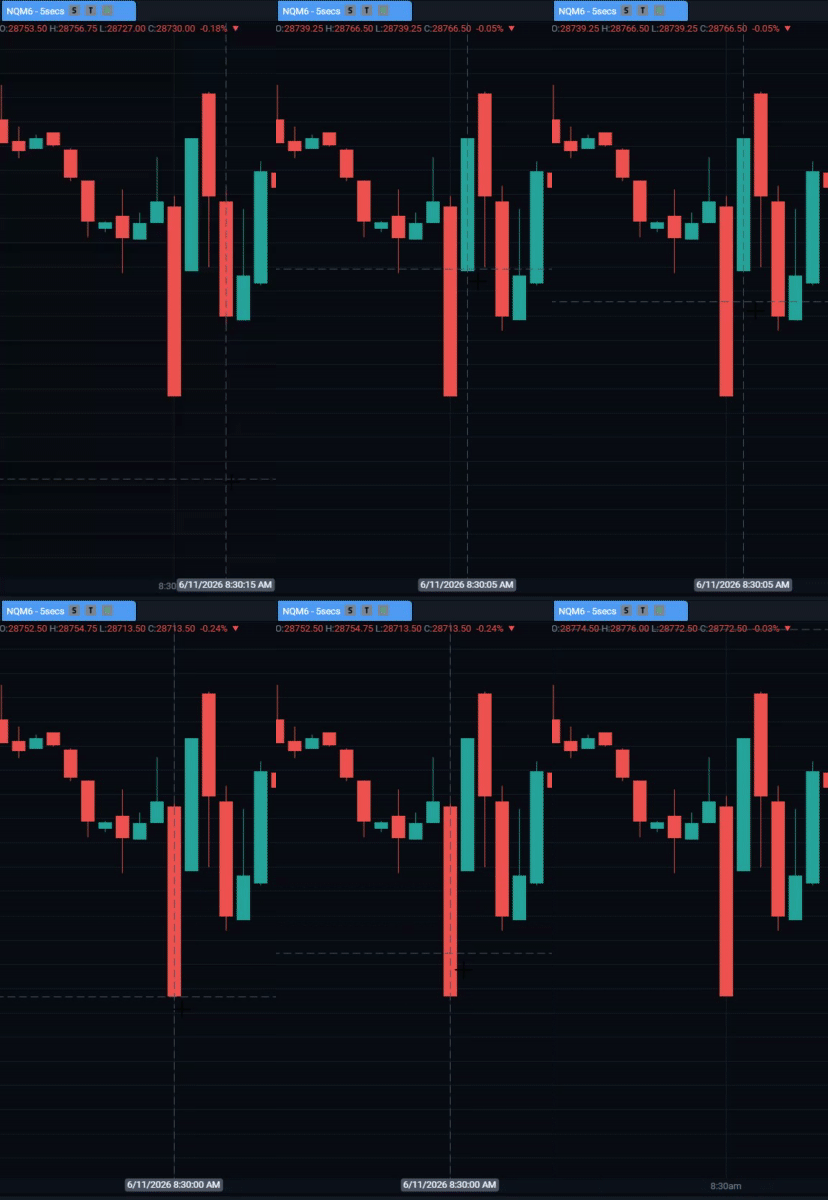
Velocity logic is designed to detect unusually rapid price movement over very short periods of time on electronic trading platforms.
While price limits focus on how far a market moves, velocity logic focuses on the speed of that movement.
What Is Price Banding?
Price banding serves as another layer of market protection by rejecting orders entered outside an acceptable trading range.
Unlike traditional price limits, price bands operate continuously and apply regardless of whether volatility is elevated.
The acceptable trading range is calculated dynamically using the most recent market price plus or minus a predefined value. As prices shift throughout the session, these bands automatically adjust to reflect current market conditions, helping maintain orderly execution in both futures and options markets.
Please see the visual below for a 5-second CME Velocity Lock: