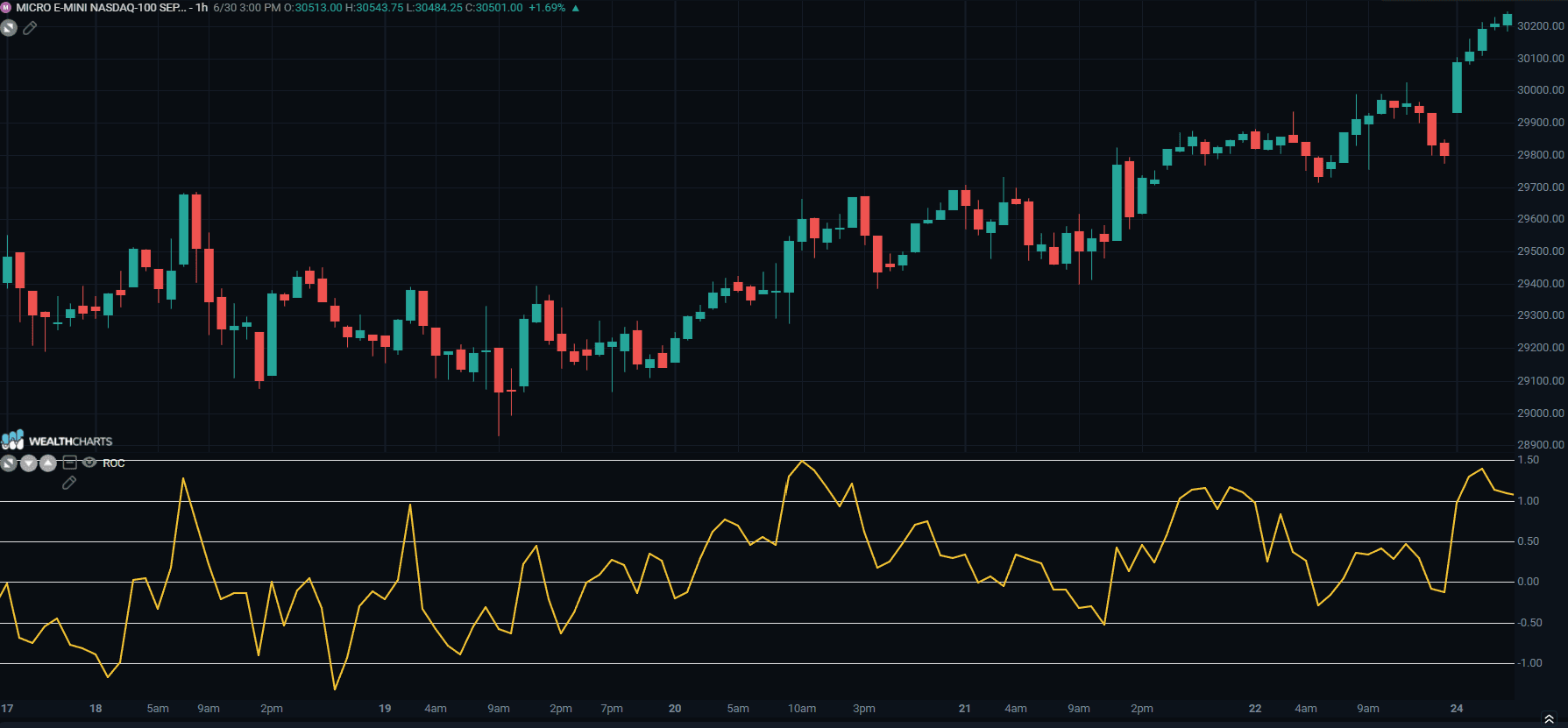
Rate Of Change (ROC) - Indicator Formula
Updated
Its construction is based on the difference between the most recent closure and the closure recorded days before in relation to the latter. In practice, it represents the momentum indicator expressed as a percentage.
Its formula is as follows:
ROC( t ) = P( t ) - P( t - 10 ) / P( t - 10 ) * 100
where:
P( t ) = price or value of the reference index at the current time
P( t - 10 ) = price or value of the reference indicator 10 days before
If the stock price today is higher than the price of n periods ago, the ROC will be a positive number, if the stock price today is lower than n periods ago, the ROC will be a negative number.
The selection of the number of periods (days) on which to calculate the ROC, depends on the reference period to be considered.
When the Rate of Change is above the Zero-Line, or positive, this represents an uptrend or a bullish opportunity.
When the Rate of Change is below the Zero-Line, or negative, this represents a downtrend or a bearish opportunity.